
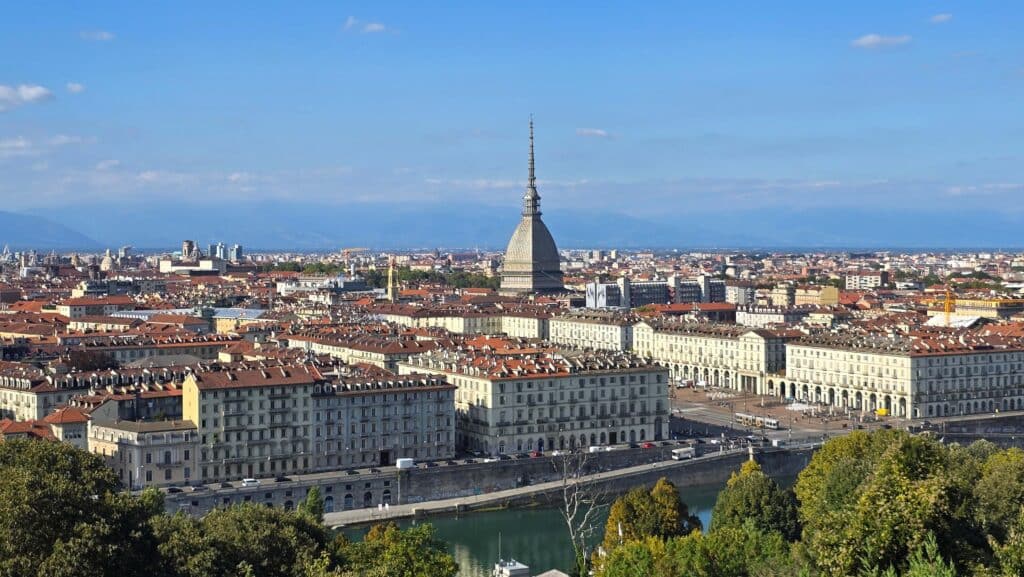
The Mole:
Secrets of the most legendary Torino’s architecture
Torino's iconic silhouette and symbol
There are cities that can be recognized by a river, a skyline, or a cathedral. Torino (Turin) can be recognized by a single silhouette, that of the Mole, like the locals address it, or the Mole Antonelliana, that for many years seemed just like an impossible dream.
First time visitors, just like habitué traveller, coming across Torino while touring Piedmont should definitely save some time to see the momument up close. Make sure that you book a guided walking tour of Torino and to include a stop by the Mole.
The first glimpse of the Mole Antonelliana is always slightly unreal. It rises above the ordered geometry of Turin like something imagined rather than engineered — too tall, too narrow, too ambitious for the nineteenth century that produced it. Even today, surrounded by modern buildings and distant Alpine peaks, the Mole seems less constructed than willed into existence.
And in many ways, it was.
The Mole Antonelliana represents the moment Torino stopped being only the royal capital of Piedmont and Italy and became an industrial, intellectual, and cultural city. It transformed over time from synagogue to civic monument, from architectural curiosity to national icon, and eventually into the home of the National Museum of Cinema — perhaps the perfect destination for a building that already looked like a scene from fiction.
Today, the Mole appears everywhere in Turin: on souvenirs, football banners, company logos, postcards, and the memories of anyone returning home by train. Like the great cathedrals described by Ken Follett, it became larger than the intentions of the people who built it.
That may be the real destiny of iconic buildings. They cease to belong to architects, governments, or even history itself. Eventually, they belong to everyone.
Index
The Mole: the symbol of Torino
The construction and secrects of The Mole Antonelliana
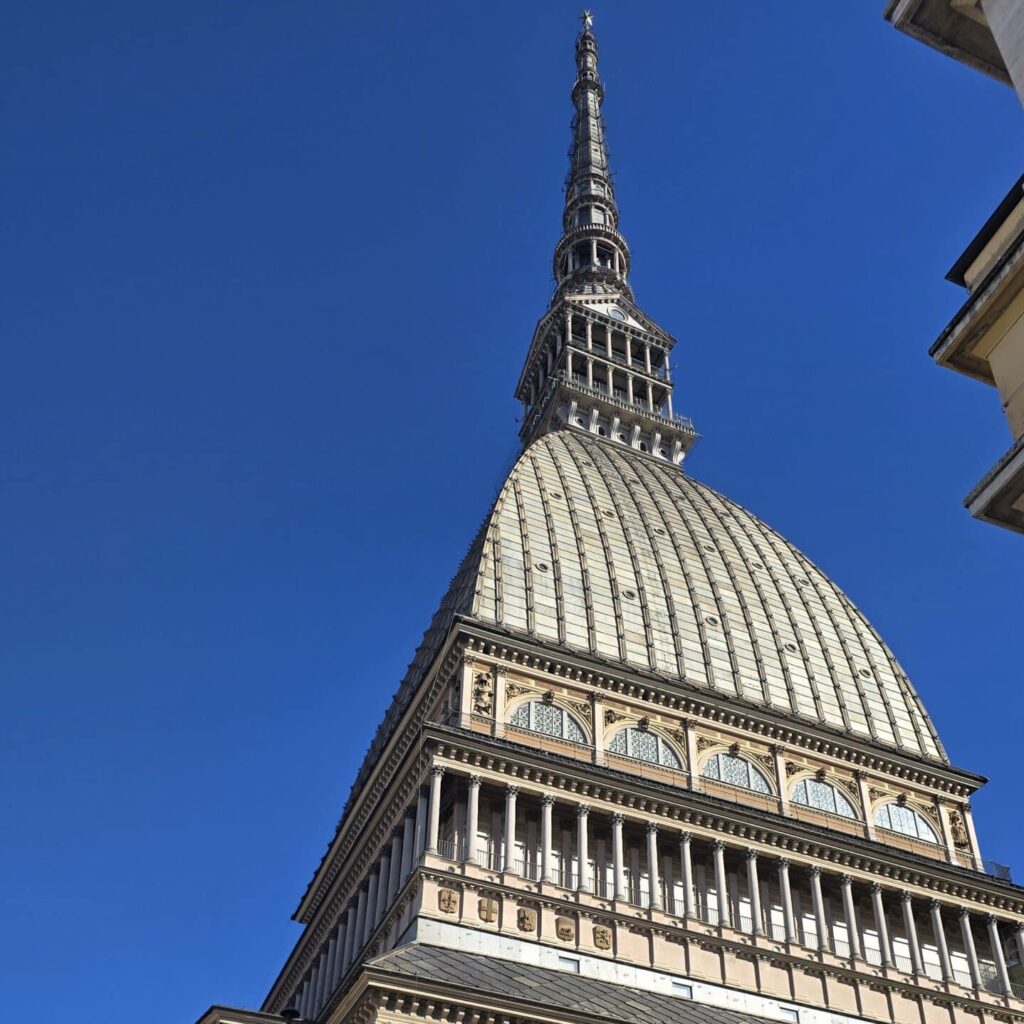
When the project began in 1863, the building was not supposed to become the symbol of Turin at all. It was commissioned as a synagogue for the city’s Jewish community, shortly after the emancipation of Italian Jews in the newly unified Kingdom of Italy. The architect, Alessandro Antonelli, proposed a structure unlike anything Europe had seen: a towering dome of masonry climbing toward the sky with almost irrational confidence.
But Antonelli was incapable of moderation.
As the years passed, the building grew taller and more expensive. The original plans became merely a starting point for the architect’s imagination. Costs exploded. Arguments multiplied. The Jewish community eventually abandoned the project altogether, exchanging the unfinished structure with the city of Turin. Yet Antonelli continued, obsessed with height, proportion, and spectacle.
Althought it seemed like a dream impossible to complete the result was extraordinary. By the end of the nineteenth century, the Mole had become one of the tallest masonry buildings in the world — a monument to engineering daring at a moment when Italy itself was still inventing its national identity.
And yet the Mole was never stable for long.
Storms repeatedly damaged its spire. In 1953, a violent tornado destroyed the upper section entirely, collapsing forty-seven meters of the structure into the streets below. For many Turinese, it felt impossible that the city could exist without its tower. Reconstruction began almost immediately. The rebuilt spire, reinforced with steel, restored not only a skyline but a civic symbol.
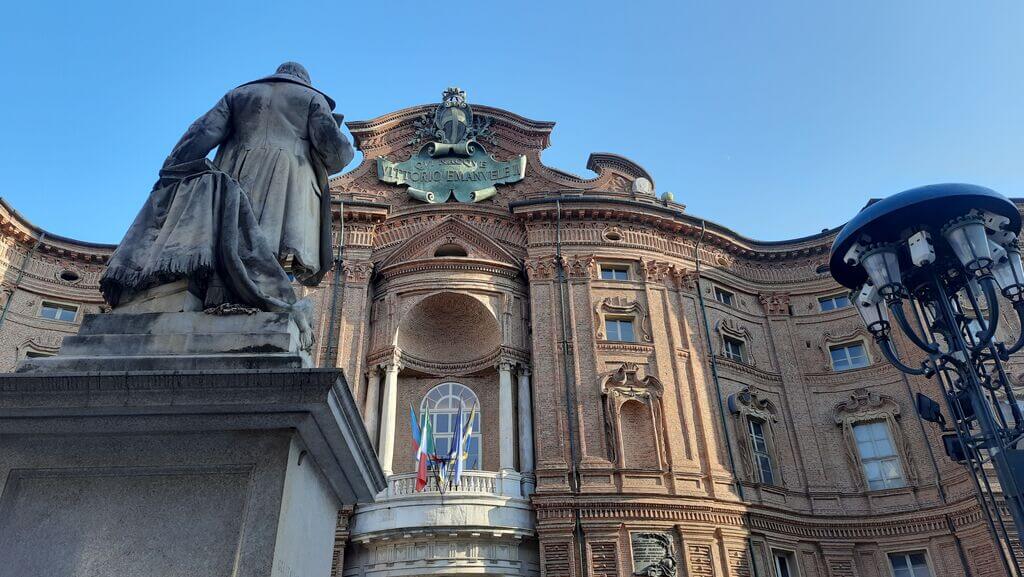
Private walking tours of Torino with expert local guides
This is perhaps why the Mole matters so deeply to Torino. It has never been merely useful. Unlike a cathedral, it was not the center of religious life. Unlike a palace, it was never the seat of power. Its meaning comes from something more modern: aspiration.
Antonelli himself is essential to the story because the Mole is almost a psychological portrait of its architect. One of the reasons the building feels so unusual is that Alessandro Antonelli was unusual: brilliant, obsessive, technically daring, and notoriously incapable of respecting limits.
Piedmont Tours
Langhe Food & Wine Tours
Authentic Experiences in the heart of Piedmont, Italy
Alessandro Antonelli
The Mole as a psychological portrait of its architect
No story of the Mole can be separated from that of the man who imagined it.
Alessandro Antonelli was born in Ghemme, in Piedmont, in 1798, at a time when Napoleon still dominated much of Europe. He studied architecture in Milan at the Accademia di Brera, where he absorbed the strict language of Neoclassicism. Yet Antonelli would spend much of his life quietly rebelling against architectural restraint.
He belonged to a generation that saw architecture not merely as decoration, but as an expression of modern possibility. While many nineteenth-century architects focused on historical styles, Antonelli became fascinated by height, verticality, and structural experimentation. His buildings often seemed to challenge gravity itself.
Before the Mole, he had already gained recognition in Piedmont and northern Italy through churches, urban projects, and restorations, including the dome of the Basilica of San Gaudenzio in Novara — another astonishing vertical structure that appears to anticipate the ambitions of the Mole itself. Even there, contemporaries questioned whether his designs were too daring to stand safely.
Those concerns followed him throughout his career.
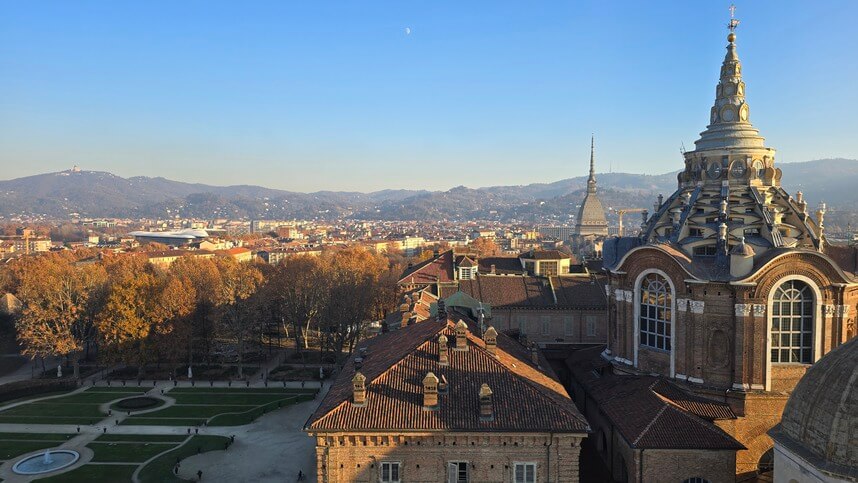
Antonelli was famous for continually modifying his own projects during construction. Budgets expanded, deadlines disappeared, and clients often lost patience. The Mole Antonelliana became the clearest example of this tendency: what began as a relatively conventional synagogue evolved, under Antonelli’s relentless revisions, into a colossal architectural experiment. The building grew taller and taller because the architect himself seemed unable to stop imagining new possibilities for it.
By the final decades of his life, Antonelli had become both admired and controversial — celebrated as a visionary by some, criticized as impractical by others. Yet even his critics understood that they were witnessing a rare kind of architectural ambition.
Unlike many famous architects of later centuries, Antonelli did not cultivate a clearly identifiable “school” of disciples. Architecture in nineteenth-century Italy still operated largely through ateliers and technical collaborators rather than celebrity partnerships. However, engineers, builders, and site supervisors worked closely with him for decades on complex projects that required constant adaptation.
One important collaborator associated with the later completion and technical continuation of the Mole was his son, Costanzo Antonelli, who helped oversee aspects of the work after Alessandro Antonelli’s death in 1888. The project itself outlived its creator — perhaps appropriately for a building conceived on such impossible scale.
Today, the Mole remains inseparable from Antonelli’s personality. It is not simply a monument designed by him; it feels like the physical manifestation of his imagination: ambitious, eccentric, fragile, and unforgettable.
The paradox of the Mole Antonelliana
Permanence versus Fragility
Every monumental building is created to resist time. Yet the paradox of the Mole Antonelliana is that its history has always been marked by vulnerability.
From a distance, the tower appears eternal. Its silhouette dominates Turin with such certainty that it feels inseparable from the city itself, as though it had always existed and always will. But the closer one looks at the history of the Mole, the more surprising its fragility becomes.
This fragility begins with the building’s very conception. Alessandro Antonelli imagined a structure that pushed nineteenth-century masonry to extraordinary limits. Long before steel skyscrapers transformed urban skylines, he attempted to achieve immense verticality using traditional construction methods, relying on brick, stone, weight distribution, and geometric precision. The Mole was not simply tall; it was almost impossibly tall for its time.
The result was magnificent, but also precarious. Engineers and politicians repeatedly questioned whether the structure could safely sustain its own weight. During construction, modifications and reinforcements became constant necessities. The building seemed suspended between visionary triumph and potential collapse.
Nature itself would later expose that tension dramatically.
In 1953, a violent storm struck Turin and tore away the upper portion of the Mole’s spire. Nearly fifty meters of the structure crashed to the ground. Photographs from the aftermath are unsettling: the city’s defining symbol suddenly mutilated, incomplete, almost mortal. For many inhabitants, the damage carried an emotional force greater than the destruction of ordinary architecture. The skyline itself appeared wounded.
And yet the Mole survived precisely because the city refused to imagine Turin without it.
Reconstruction began quickly, this time with modern steel reinforcements hidden within the rebuilt spire. The restoration preserved the building’s familiar appearance while quietly acknowledging a truth Antonelli himself had perhaps resisted: even the grandest monuments require adaptation in order to endure.
That tension between permanence and fragility may explain why the Mole continues to resonate so powerfully today. Truly iconic buildings are never invulnerable. Cathedrals burn. Towers collapse. Domes crack. Time eventually reaches everything humanity constructs.
What gives these structures meaning is not immortality, but persistence — the repeated human decision to preserve them despite their vulnerability.
The Mole Antonelliana therefore stands not as proof that architecture can defeat time, but as evidence that societies continually choose what deserves to survive.
Personalize your private tour of Piedmont
The architect rational engineering and obsessions
Beyond architectural limits
Great monuments are often born from a dangerous balance between calculation and obsession. Without engineering discipline, they collapse. Without obsession, they are never imagined in the first place.
The Mole Antonelliana exists because Alessandro Antonelli repeatedly ignored the limits that more cautious architects would have accepted.
To his admirers, Antonelli represented the triumph of imagination over convention. To his critics, he was a perfectionist incapable of restraint — an architect who transformed every commission into an endless experiment. Budgets, schedules, and original plans mattered less to him than the pursuit of height, lightness, and spectacle.
The Mole became the ultimate expression of that temperament..
The Mole's transcending purpose
Civic utility or symbolic meaning
Most buildings begin with a practical purpose. The Mole Antonelliana eventually transcended its own, and from impossible dream it became a tangible reality.
It was designed as a synagogue, became a civic possession, survived as an architectural curiosity, and finally evolved into the symbolic heart of Turin itself. Millions of people recognize its silhouette without knowing its original function.
This transformation reveals something important about monumental architecture: cities eventually choose their symbols independently of the intentions of architects or patrons.
How to start planning your trip to Torino and Piedmont
1. Contact Us
Reach out to www.piedmontours.com and a dedicated travel advisor will help you customize your Piedmont trip. Schedule phone calls and video calls along with your travel mates, and share your thoughts.
2. Choose Your Itinerary and Activities
Select your preferred destinations and tours from a wide range of choices: from private Torino walking tours, private and group winery tours, wine e-bike tours, culinary classes, and a lot more. And if you have something in mind that is not advertised on our website, don’t hesitate to ask anyway. We will be happy to make your dream come true.
3. Personalized Travel Proposal
Choose from a list of recommended charming accommodations, including hotels, villas, and vacation rentals. Enjoy the comfort of rental cars at your disposal or rely on licensed private drivers during the entirety of your stay. We will take care of your transfers from the airport all the way to your tour destination.
4. Relax and Enjoy Piedmont
With everything planned and organized, all you need to do it is enjoy a well earned get away and make cherished memories. We will be by your side before your arrival and during your stay, to make sure you have the best time while in Piedmont and Italy.
FAQ
The best times of the year to plan a trip to Piedmont are spring, early summer and autumn, when the weather is mild and the coutryside displays bright colours. Many fairs happen to take place during those months and the region is filled with events
Depending on the lenght of your holiday away from home, we suggest you to spend from 3 to 12 days in the region. Then if you are inclined, you can consider adding other Italian destinations to your itinerary, such as Parma, Bologna, Milano, Venezia, Cinque Terre, Firenze
Yes, from the moment you land at the airport, Piedmont Tours will be by your side with licensed private drivers, assistance with train tickets, hotel and villas reservation, as well as guided tours and restaurant reservations
Yes, your dedicated travel designer at Piedmontours will help you create the ideal itinerary for your trip, including also other Italian regions and cities

- Terra Madre Turin 2026: Food, Piedmont & Carlo Petrini - August 31, 2026
- The Mole: Secrets of the most legendary Torino’s Architecture - August 6, 2026
- 2025 Guide to Piedmont Wines - March 5, 2025